
October is a great time to start thinking about staff development for the coming year.
For many libraries, the last few months of the year are filled with budgets, strategic planning, annual reports, holidays, and preparing for the year ahead. Continuing education can easily become something that gets handled at the last minute: “We have some training money left. What webinar can we find?”
But continuing education can be much more valuable when it is planned intentionally.
As libraries begin looking toward 2027, October is a good time to take a step back and ask:
What do our staff members need to learn, improve, or explore next year?
Start With Your Staff—Not the Calendar
It can be tempting to begin CE planning by looking at upcoming conferences and webinars. Instead, start by talking with your employees.
Consider asking staff members questions such as:
- What is one skill you would like to improve in 2027?
- What would make your job easier or more effective?
- Is there something about library services you would like to learn more about?
- Are there technologies or tools you would like to become more comfortable using?
- What training would help you work more effectively with patrons or coworkers?
- Is there an area of the library where you would like to take on additional responsibilities?
- What training have you attended in the past that was particularly useful?
- What training wasn’t useful—and why?
These conversations can reveal needs that may not appear in a formal evaluation or staff survey.
Look Beyond Technology
Technology is certainly an important part of library staff development, but it shouldn’t be the entire CE plan.
Libraries also need employees who can communicate effectively, work as teams, handle difficult situations, provide excellent customer service, manage projects, conduct outreach, and adapt to changing community needs.
A well-rounded 2027 training plan might include topics such as:
Customer Service
- De-escalation and difficult patron interactions
- Creating welcoming library environments
- Understanding the patron experience
Communication
- Communicating with different personality types and styles
- Active listening
- Communication in virtual and hybrid environments
- Giving and receiving feedback
Leadership and Management
- Developing new supervisors
- Coaching employees
- Managing conflict
- Building effective teams
- Leading through change
Outreach and Marketing
- Social media and public relations
- Photography for library promotion
- Community partnerships
- Telling the library’s story
Technology and AI
- Practical applications of AI
- Digital literacy
- Emerging technologies
- Evaluating technology tools and services
Professional Development
- Career development
- Presentation skills
- Project management
- Time management
- Building confidence in the workplace
Don’t Forget the “Soft Skills”
Some of the most important skills library employees use every day aren’t necessarily technical skills.
Communication, collaboration, empathy, adaptability, problem-solving, conflict management, and leadership all have a direct impact on the experience of both employees and library users.
These skills also tend to be transferable. An employee who becomes a better communicator isn’t just improving one particular task—they may become better at working with coworkers, assisting patrons, participating in meetings, handling challenging situations, and representing the library in the community.
Consider Different Ways to Learn
Continuing education doesn’t have to mean sending everyone to an expensive conference.
A 2027 staff development plan could include a combination of:
- Webinars
- Conferences
- Workshops
- Online courses
- Professional association programs
- In-house training
- Peer-to-peer learning
- Staff discussion groups
- Book or article discussions
- Cross-training
- Mentoring
- Job shadowing
- Individual professional development projects
Libraries can also bring trainers into the library for an entire staff development day or schedule a series of shorter sessions throughout the year.
The important question isn’t simply “What training can we afford?”
It is:
“What combination of learning opportunities will help our employees and our library succeed?”
Create a Simple 2027 CE Plan
You don’t need a complicated system.
Consider creating a simple spreadsheet with columns for:
Staff Member | Training Need | Topic | Type of Training | Estimated Cost | Target Date | Completed
You could also organize training into three categories:
Required: Training that everyone needs, such as safety, policies, or compliance-related topics.
Recommended: Training that supports the library’s current goals and priorities.
Individual: Professional development selected based on an employee’s particular interests, responsibilities, or career goals.
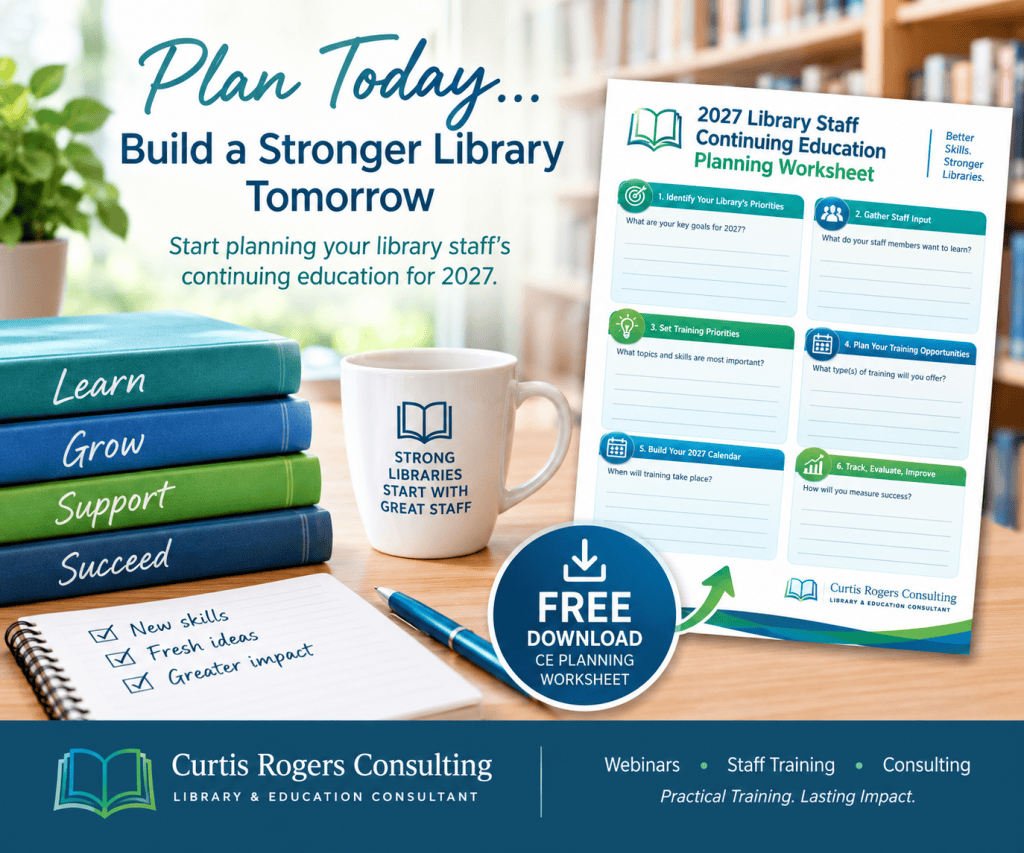
This approach can make it easier to balance organizational needs with individual professional development. Click below for a free download and develop your next Continuing Education Plan today!
Make Training Part of the Culture
One of the biggest mistakes a library can make is treating continuing education as an occasional event rather than an ongoing part of the workplace culture.
Training shouldn’t end when the webinar ends.
After a training session, consider asking:
- What did you learn?
- What could we apply here?
- Is there something we should change?
- Would this benefit other staff members?
- What additional training would be helpful?
Even a 15-minute conversation after a training session can help turn information into action.
October Is the Time to Start
You don’t have to have your entire 2027 continuing education calendar finalized in October.
But you can start.
Talk with your staff. Review your library’s goals. Look at areas where employees may need additional support. Identify emerging skills. Set aside some professional development funding. Begin watching for conferences, webinars, workshops, and other opportunities.
And most importantly, remember that continuing education is an investment in your library’s people.
When employees have opportunities to learn, grow, and develop new skills, the benefits can extend far beyond the individual employee. Staff development can strengthen teamwork, improve services, increase confidence, and help libraries respond more effectively to the changing needs of their communities.
So, as you begin planning for 2027, don’t just ask, “What training should we offer?”
Ask:
“What do we want our staff—and our library—to be better at one year from now?”
That question may lead you to a much more meaningful continuing education plan.
Need Help Planning Staff Development?
If your library is looking for practical continuing education opportunities for 2027, I offer one-hour webinars and staff training sessions for public and academic libraries on topics including communication, leadership, meetings, onboarding, photography, outreach, marketing, and other professional development topics.
I also work with libraries on customized training and staff development needs.
Interested in bringing a webinar or training session to your library in 2027?
Contact me at curtisrogersconsulting@gmail.com or visit curtisrogersconsulting.com to learn more about my consulting and training services.


